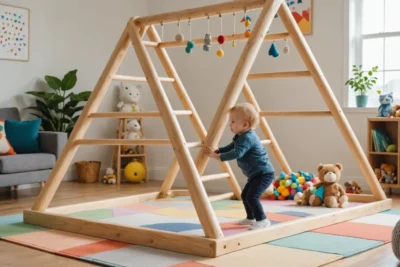
Why Are Pikler Triangles So Expensive? Cost Breakdown 2026

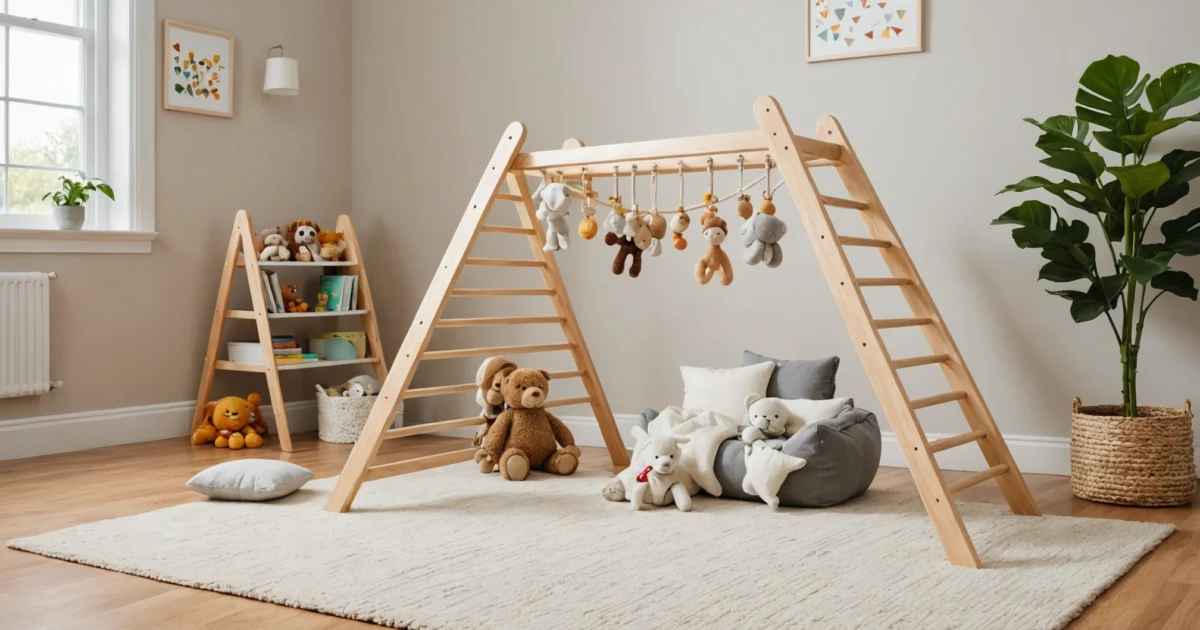
Pikler triangles are so expensive because they combine premium hardwood materials, handcrafted manufacturing, rigorous safety certifications, and specialized child development research. Most authentic Pikler triangles cost between $200-$600 due to their use of sustainable hardwoods like birch and beech, small-batch artisan production, and compliance with strict safety standards like CPSIA and EN71. Additionally, these climbing structures require significant investment in Montessori and Pikler methodology research, precision engineering for load-bearing capacity, and non-toxic finishes that meet child safety requirements.
Unlike mass-produced plastic toys, Pikler triangles are positioned as premium developmental tools that must withstand years of active use while supporting children’s gross motor development. Furthermore, the limited competition in the authentic Pikler triangle market allows manufacturers to maintain higher pricing for these specialized educational climbing structures.
The high cost also reflects the target demographic of conscious parents willing to invest in quality developmental tools that offer long-term value. However, understanding these cost factors helps parents make informed decisions about whether the investment aligns with their family’s needs and budget.
TL;DR
- Premium materials: Sustainable hardwoods, non-toxic finishes, and quality hardware drive up production costs significantly
- Handcrafted manufacturing: Small-batch artisan production and skilled labor in developed countries increase pricing compared to mass manufacturing
- Safety certifications: Rigorous testing, compliance with CPSIA/EN71 standards, and liability insurance add substantial costs
- Research investment: Integration of Montessori/Pikler methodology and child development expertise requires ongoing R&D funding
- Market positioning: Premium brand positioning and limited authentic competition allow manufacturers to maintain higher profit margins
Material Quality and Sourcing Costs
The foundation of Pikler triangle pricing lies in premium hardwood selection, where manufacturers prioritize birch, beech, and maple for their exceptional strength-to-weight ratios. These hardwoods cost 3-5 times more than softwoods like pine, yet their dense grain structure provides the load-bearing capacity necessary for active climbing. Moreover, birch plywood specifically offers superior dimensional stability, preventing warping under stress while maintaining smooth surfaces that protect children’s hands during play.
Sustainable forestry practices significantly impact material costs, as manufacturers increasingly source FSC-certified wood that meets environmental standards. This certification process requires extensive documentation, chain-of-custody tracking, and premium pricing that can add 20-30% to raw material costs. Additionally, European hardwoods command higher prices than alternatives from developing regions, yet their consistent quality and sustainable harvesting practices justify the investment for premium climbing structures.
Non-Toxic Finish Requirements
Child-safe finishes represent another significant cost factor, as manufacturers must use water-based, non-toxic coatings that meet stringent safety standards. These specialized finishes cost 40-60% more than conventional wood stains, yet they provide essential protection without releasing harmful volatile organic compounds (VOCs). Furthermore, the application process requires multiple thin coats and extended drying times, increasing labor costs while ensuring optimal durability and safety.
Natural oil finishes like tung oil and linseed oil offer food-safe alternatives that enhance wood grain visibility while providing moisture protection. However, these finishes require careful sourcing to ensure purity and may need periodic reapplication, factors that influence both initial pricing and long-term maintenance considerations for families.
Hardware Quality and Safety Mechanisms
| Component | Standard Grade | Premium Grade | Cost Difference |
|---|---|---|---|
| Screws | Zinc-plated steel | Stainless steel | 300% higher |
| Hinges | Basic piano hinge | Heavy-duty brass | 250% higher |
| Safety locks | Simple latch | Child-resistant mechanism | 400% higher |
| Corner brackets | Stamped metal | Machined aluminum | 200% higher |
Quality hardware specifications drive substantial cost increases, as stainless steel screws resist corrosion while providing superior holding power compared to standard fasteners. These premium fasteners cost significantly more yet prevent loosening over time, ensuring structural integrity throughout years of active use. Similarly, heavy-duty hinges must withstand repeated folding cycles while maintaining smooth operation and precise alignment.
Safety mechanisms incorporate sophisticated engineering, including child-resistant locks that prevent accidental folding while allowing easy adult operation. These specialized components require precision manufacturing and rigorous testing, contributing to higher material costs while ensuring compliance with safety standards. Additionally, rounded corner brackets and smooth edge treatments eliminate sharp surfaces, requiring additional machining processes that increase production expenses.
Premium materials account for approximately 40-50% of total Pikler triangle production costs
Handcrafted Manufacturing Process
Artisan manufacturers produce Pikler triangles in small batches rather than mass-produced factory lines, fundamentally altering cost structures and pricing models. These craftspeople typically create 20-50 units per month compared to industrial facilities that output thousands of identical products. Consequently, each triangle receives individual attention throughout the manufacturing process, eliminating economies of scale while ensuring superior quality control.
Small-batch production requires skilled woodworkers who command higher wages in developed countries like Germany, Denmark, and the United States. Furthermore, these artisans possess specialized knowledge of child safety requirements and traditional woodworking techniques that mass manufacturers often overlook. Their expertise translates directly into labor costs that can represent 60-70% of total production expenses.
Precision Manufacturing Requirements
Cutting operations demand exceptional accuracy to ensure proper joint alignment and structural integrity across all components. Skilled craftspeople use precision tools to achieve tolerances within ±0.5mm, preventing gaps that could compromise safety or stability. Moreover, each piece undergoes multiple cutting stages, from rough dimensioning to final shaping, requiring significant time investment per unit.
Sanding processes involve multiple grits progressing from coarse to fine, typically starting at 80-grit and finishing with 220-grit or higher. This meticulous approach removes tool marks while creating smooth surfaces that protect children from splinters. Additionally, hand-sanding reaches areas that automated equipment cannot access, ensuring consistent texture across complex geometries.
Manufacturing Time Breakdown
Finishing applications require controlled environments and specialized techniques that prevent contamination while ensuring even coverage. Craftspeople apply multiple thin coats rather than single thick applications, allowing proper curing between layers. This approach prevents drips, runs, and uneven color distribution that could affect both appearance and durability.
Individual Quality Control Standards
Each triangle undergoes comprehensive inspection at multiple production stages, from initial wood selection through final assembly verification. Quality control specialists examine grain patterns, check joint tightness, and test moving components before products leave the workshop. These individual assessments prevent defective units from reaching customers while maintaining brand reputation.
Inspection protocols include stress testing that simulates years of typical use, ensuring structural integrity under dynamic loads. Craftspeople apply 150-200 pounds of force to various points while checking for flex, creaking, or joint movement. Similarly, they verify that all hardware operates smoothly and safety mechanisms function correctly under repeated activation cycles.
Documentation requirements mandate detailed records for each unit, including wood lot numbers, finish batch information, and inspection results. This traceability system enables manufacturers to address quality issues quickly while providing accountability throughout the production chain. However, maintaining these records adds administrative overhead that mass producers typically avoid through standardized processes.
Handcrafted manufacturing justifies premium pricing through superior quality outcomes, yet these artisanal methods inherently limit production capacity while increasing per-unit costs. Therefore, families seeking value assessment guidance must weigh handcrafted benefits against budget considerations when selecting climbing equipment for their children.
Safety Standards and Certifications
Safety certifications represent one of the most significant cost drivers in Pikler triangle manufacturing, as children’s climbing equipment must undergo rigorous testing protocols mandated by multiple regulatory bodies. Manufacturers invest thousands of dollars per product line to achieve compliance with CPSIA (Consumer Product Safety Improvement Act), EN71 European safety standards, and ASTM International specifications. These certification processes require independent laboratory testing that can cost between $15,000 to $50,000 per product variant, depending on complexity and testing scope.
Testing laboratories subject each design to comprehensive evaluation protocols that examine structural integrity, chemical composition, and age-appropriate safety features. Load-bearing capacity tests apply forces exceeding normal use patterns, typically requiring triangles to withstand 300-500 pounds of distributed weight without structural failure. Additionally, impact testing simulates falls and collisions while durability assessments cycle components through thousands of repeated stress applications.
Chemical safety testing analyzes wood finishes, adhesives, and hardware for toxic substances including lead, phthalates, and formaldehyde. Laboratory technicians extract samples from various product areas and subject them to spectroscopic analysis, ensuring compliance with strict limits on hazardous materials. Furthermore, flammability testing verifies that materials meet fire resistance standards required for children’s products.
Certification Timeline
Structural engineering consultations add another layer of expense as manufacturers engage professional engineers to validate design calculations and safety margins. These engineers analyze stress distribution patterns, joint configurations, and material properties to ensure products exceed safety requirements by substantial margins. Engineering reports cost between $5,000 to $15,000 per design, yet they provide essential documentation for certification authorities and liability protection.
Age-appropriate design considerations require extensive research into child development patterns and motor skill progression, influencing everything from rung spacing to overall dimensions. Manufacturers must demonstrate that their products suit specific age ranges while preventing misuse by younger children who lack necessary coordination skills. This research often involves consulting with pediatric occupational therapists and child development specialists, adding professional consultation fees to development costs.
Liability insurance premiums reflect the inherent risks associated with children’s climbing equipment, with manufacturers paying significantly higher rates than producers of static toys. Insurance companies assess product liability exposure based on injury potential, user age demographics, and historical claim data from similar products. Annual premiums can reach $50,000 to $200,000 for smaller manufacturers, while larger companies may pay substantially more based on sales volume and market exposure.
Ongoing compliance monitoring requires manufacturers to maintain quality systems that document production processes, material sourcing, and testing protocols throughout the product lifecycle. ISO 9001 quality management systems mandate detailed record-keeping that tracks every component from raw materials through final assembly. These documentation requirements necessitate dedicated quality assurance personnel and sophisticated tracking systems that add operational overhead to manufacturing costs.
Regulatory changes periodically require recertification or design modifications, creating unexpected expenses that manufacturers must absorb or pass along to consumers. For example, updates to CPSIA requirements in recent years forced many toy manufacturers to invest in additional testing and documentation procedures. Consequently, companies maintain compliance reserves to address regulatory changes without disrupting production schedules or compromising safety standards.
International market access multiplies certification expenses as manufacturers seeking global distribution must satisfy safety standards in multiple jurisdictions. European CE marking requires different testing protocols than North American standards, while countries like Australia and Japan maintain their own specific requirements. Therefore, companies targeting international markets often invest $100,000 or more in comprehensive certification portfolios that enable worldwide sales while ensuring consistent safety performance across all markets.
Research and Development Investment
Behind every quality Pikler triangle lies extensive research and development investment that manufacturers must recoup through product pricing. Companies developing authentic climbing structures invest heavily in child development research to ensure their designs align with proven educational methodologies. This research phase typically requires 12-18 months of consultation with early childhood specialists, developmental psychologists, and Montessori educators who command premium consulting fees ranging from $150-300 per hour.
The integration of Montessori and Pikler methodology research demands comprehensive understanding of motor skill development, spatial awareness progression, and age-appropriate challenge levels. Manufacturers collaborate with Pikler approach specialists to validate design elements against Dr. Emmi Pikler’s original principles of free movement and natural development. Furthermore, these consultations ensure climbing structures support gross motor development while respecting children’s innate learning rhythms.
Prototype development and testing phases consume substantial resources as manufacturers create multiple iterations before finalizing designs. Each prototype cycle costs $5,000-15,000 in materials, machining, and assembly labor, with most companies producing 8-12 prototypes during development. Additionally, extensive field testing with children requires specialized facilities, insurance coverage, and trained observers who document developmental outcomes over 6-month periods.
Development Timeline
Educational outcome validation drives significant additional investment as manufacturers measure how their designs impact child development milestones. Companies conduct longitudinal studies tracking balance improvement, confidence building, and problem-solving skill development in children using their climbing structures. These studies require statistical analysis, peer review, and documentation that meets academic standards, often costing $25,000-50,000 per comprehensive evaluation.
Design refinement based on educational outcomes creates iterative cycles where manufacturers modify dimensions, angles, and surface textures to optimize developmental benefits. Each refinement cycle requires new prototypes, additional testing, and validation studies that extend development timelines significantly. Consequently, manufacturers must factor these extended development costs into final pricing while ensuring their investment produces measurably superior educational outcomes compared to generic climbing toys.
The expertise required for authentic Pikler triangle development extends beyond traditional toy design to encompass child psychology, motor development theory, and educational pedagogy. Manufacturers often maintain ongoing relationships with child development consultants who provide guidance throughout the product lifecycle, from initial concept through post-market educational effectiveness studies. These consulting relationships, while essential for creating developmentally appropriate products, represent ongoing operational expenses that distinguish research-backed climbing structures from mass-produced alternatives.
Brand Positioning and Market Factors
Premium positioning fundamentally shapes Pikler triangle pricing strategies within the educational toy marketplace. Manufacturers deliberately position these climbing structures as developmental investments rather than simple toys, targeting parents who prioritize quality over affordability. This positioning strategy enables companies to command higher prices while attracting customers specifically seeking authentic Montessori and Waldorf-inspired learning tools.
Target demographics willing to invest in quality developmental tools drive market pricing dynamics significantly. Conscious parenting communities actively seek products aligned with respectful childcare philosophies, often budgeting $200-500 for single educational items. These parents research extensively, comparing authentic Pikler triangles against mass-produced alternatives while prioritizing long-term developmental benefits over immediate cost savings.
Limited competition in the authentic Pikler triangle space creates favorable pricing conditions for established manufacturers. Unlike mass-market toy categories with hundreds of competitors, the authentic climbing triangle market contains fewer than 20 serious manufacturers worldwide. This scarcity allows companies to maintain premium pricing without significant pressure from low-cost alternatives flooding the market.
Market Positioning Strategy
Marketing costs for reaching conscious parenting communities represent substantial operational expenses that influence final pricing. Companies invest heavily in targeted digital marketing campaigns across parenting blogs, Montessori forums, and social media platforms where their ideal customers actively seek educational product recommendations. These specialized marketing channels often cost 40-60% more than general toy advertising due to their niche focus and higher engagement requirements.
Brand authenticity verification requires ongoing investment in educational content creation and community engagement. Manufacturers maintain relationships with child development experts, sponsor research studies, and produce extensive educational resources demonstrating proper usage techniques. These authenticity-building activities, while essential for maintaining premium positioning, add significant ongoing costs that generic toy manufacturers typically avoid.
Distribution strategies further impact pricing structures within this specialized market segment. Premium Pikler triangle manufacturers often eschew mass retail channels, instead focusing on specialty educational toy stores and direct-to-consumer sales. These distribution approaches require higher marketing investments and customer acquisition costs compared to mass retail placement, ultimately reflected in product pricing.
Customer lifetime value calculations justify premium pricing strategies for authentic climbing triangle manufacturers. Parents purchasing quality Pikler triangles often become repeat customers for complementary products like balance boards, climbing arches, and other Pikler approach materials. This extended customer relationship enables companies to invest more heavily in initial product quality and customer acquisition while maintaining profitable long-term business models.
Long-term Value Proposition
Quality Pikler triangles deliver exceptional multi-generational durability that transforms their initial cost into long-term investment value. Premium hardwood construction enables these climbing structures to withstand decades of active use, often serving multiple children within families and maintaining structural integrity through extensive daily climbing sessions. Consequently, families frequently pass these climbing triangles between siblings, cousins, and even generations, dramatically reducing the per-child cost over time.
Developmental benefits justify premium pricing through measurable improvements in gross motor skills, spatial awareness, and confidence building. Research demonstrates that children using quality climbing triangles show accelerated development in balance, coordination, and risk assessment capabilities compared to those using conventional playground equipment. Furthermore, the developmental advantages compound over months and years, creating lasting improvements in physical literacy and self-confidence that extend well beyond early childhood.
Resale value retention distinguishes quality Pikler triangles from mass-produced plastic alternatives in remarkable ways. Well-maintained wooden climbing triangles typically retain 60-80% of their original value after several years of use, while plastic climbing toys often lose 80-90% of their value within the same timeframe. Additionally, demand for used quality Pikler triangles remains consistently high in secondary markets, enabling families to recoup substantial portions of their initial investment.
Multi-functional adaptability extends the useful lifespan of premium climbing triangles across different developmental stages and play scenarios. Toddlers initially use these structures for basic climbing and pulling up, while preschoolers incorporate them into complex imaginative play scenarios as forts, houses, and obstacle courses. Moreover, older children often combine climbing triangles with additional accessories like slides, ramps, and balance boards, creating evolving play environments that maintain engagement for years rather than months.
Investment calculations reveal that quality Pikler triangles cost approximately $0.50-$0.75 per day when used consistently over five years, comparing favorably to many disposable toys and entertainment options. This cost-per-use analysis becomes even more favorable when accounting for multiple children, resale value, and the elimination of replacement purchases required with lower-quality alternatives. Therefore, families viewing Pikler triangles as long-term developmental investments rather than temporary toys often find the premium pricing justified through sustained value delivery.
Cost Comparison and Alternatives
Understanding the price spectrum across different manufacturers helps families make informed purchasing decisions based on their specific needs and budgets. Premium brands like Lily & River and Wiwiurka command prices between $180-$350, while mid-range options from companies such as Goodevas and Montessori Outlet typically cost $120-$200. Budget-friendly alternatives from newer manufacturers or overseas suppliers range from $80-$150, though these often compromise on wood quality, finish durability, or safety certifications.
| Price Range | Typical Features | Expected Lifespan | Best For |
|---|---|---|---|
| $80-$120 | Basic pine construction, minimal finish | 2-3 years | Trying the concept |
| $120-$200 | Quality hardwood, good finish, some customization | 4-6 years | Single child families |
| $200-$350 | Premium materials, heirloom quality, full warranties | 10+ years | Multiple children, resale value |
DIY Construction Options
Building a Pikler triangle yourself can reduce costs to $40-$80 in materials, though this approach requires significant time investment and woodworking skills. Experienced DIY builders typically spend 15-25 hours completing a basic triangle, including planning, cutting, sanding, and assembly phases. However, achieving the precise angles, smooth finishes, and safety standards of commercial products demands intermediate to advanced carpentry abilities, specialized tools, and quality lumber selection.
Material costs for DIY projects include birch or beech lumber ($25-$40), hardware and fasteners ($8-$15), and finishing supplies ($10-$20). Nevertheless, homemade versions often lack the structural engineering and safety testing that commercial manufacturers provide, potentially compromising long-term durability and child safety. Furthermore, DIY builders must source appropriate hardware, understand load-bearing requirements, and ensure all surfaces meet child-safe standards without professional guidance.
Budget-Friendly Alternatives and Trade-offs
Several cost-effective alternatives provide similar developmental benefits while addressing budget constraints, though each involves specific compromises. Foam climbing blocks cost $60-$120 and offer safe climbing experiences for younger children, but they lack the durability and natural material benefits of wooden triangles. Additionally, foam alternatives typically have shorter lifespans and limited weight capacities, making them unsuitable for older or heavier children.
Pros
- Lower upfront investment ($60-$120)
- Safer for very young toddlers
- Lightweight and portable
- Easy storage and cleaning
Cons
- Limited durability (1-2 years typical use)
- Lower weight capacity
- Less versatile for imaginative play
- Synthetic materials only
Modular climbing sets from brands like Little Tikes or Step2 range from $100-$180 and provide multiple climbing configurations. However, these plastic alternatives often feel less stable, create noise during use, and lack the aesthetic appeal that makes wooden triangles suitable for living spaces. Moreover, plastic climbing equipment typically shows wear more quickly and cannot be easily repaired or refinished like quality wooden alternatives.
Some families choose adjustable climbing frames or indoor jungle gyms priced between $150-$300, which offer greater climbing variety but require significantly more space. These alternatives excel in providing diverse physical challenges but sacrifice the focused developmental benefits and space efficiency that make Pikler triangles particularly valuable for smaller homes or apartments.
When the Investment Makes Financial Sense
The financial justification for premium Pikler triangles becomes strongest for families with multiple children, limited living space, or strong preferences for natural materials and sustainable toys. Households planning to have 2-3 children can amortize the cost across multiple users, effectively reducing the per-child investment to $60-$120 even for premium models. Additionally, families who value long-term developmental benefits over short-term entertainment often find the sustained engagement justifies higher upfront costs.
Urban families with limited outdoor access particularly benefit from investing in quality indoor climbing equipment, as Pikler triangles provide essential gross motor development opportunities year-round. Similarly, families committed to Montessori or Waldorf educational philosophies often prioritize natural materials and open-ended play equipment, making premium wooden triangles align with broader parenting investments and values.
Families using quality Pikler triangles for 5+ years report average cost-per-use of $0.40-$0.75 daily, comparable to many subscription services or regular entertainment expenses.
Conversely, families uncertain about their children’s interest in climbing activities, those with ample outdoor play spaces, or households facing significant budget constraints might benefit from starting with mid-range options or quality used triangles. Testing the concept with a $120-$150 investment allows families to evaluate usage patterns and developmental benefits before potentially upgrading to premium models or exploring additional accessories.
Frequently Asked Questions
Why are Pikler triangles so expensive compared to other climbing toys?
Pikler triangles are expensive because they combine premium hardwood materials, handcrafted manufacturing, rigorous safety certifications, and specialized child development research. Unlike mass-produced plastic toys, they use sustainable hardwoods like birch and beech, require small-batch artisan production, and must comply with strict safety standards like CPSIA and EN71.
What materials make Pikler triangles cost so much?
Pikler triangles use premium hardwoods like birch, beech, and maple that cost 3-5 times more than softwoods. These materials provide exceptional strength-to-weight ratios and load-bearing capacity. Additionally, FSC-certified sustainable wood adds 20-30% to material costs, and non-toxic finishes cost 40-60% more than conventional coatings.
How much do authentic Pikler triangles typically cost?
Most authentic Pikler triangles cost between $200-$600 depending on size, materials, and manufacturer. This pricing reflects the premium materials, handcrafted construction, safety certifications, and specialized design research that goes into each climbing structure.
What safety certifications do Pikler triangles need?
Authentic Pikler triangles must comply with strict safety standards including CPSIA (Consumer Product Safety Improvement Act) and EN71 European safety standards. These certifications require rigorous testing, compliance documentation, and liability insurance, all of which add substantial costs to the final product.
Why are non-toxic finishes important for Pikler triangles?
Non-toxic finishes are essential because children frequently put their hands and mouths on climbing structures. Manufacturers use water-based, VOC-free coatings or natural oils like tung oil and linseed oil that are food-safe. These specialized finishes cost significantly more than conventional stains but ensure child safety.
What makes handcrafted manufacturing more expensive?
Small-batch artisan production requires skilled labor in developed countries, precision engineering for load-bearing capacity, and individual quality control. This contrasts with mass manufacturing, resulting in higher labor costs but superior craftsmanship and attention to detail.
How does Montessori research influence Pikler triangle pricing?
Pikler triangles incorporate Montessori and Pikler methodology research into their design, requiring ongoing R&D investment. This includes studying child development, gross motor skills, and optimal climbing angles. The integration of this specialized educational expertise adds to the overall cost structure.
Why is birch wood preferred for Pikler triangles?
Birch plywood offers superior dimensional stability, preventing warping under stress while maintaining smooth surfaces that protect children’s hands. Its dense grain structure provides excellent load-bearing capacity, and the light color showcases the natural wood beauty that appeals to modern families.
Are expensive Pikler triangles worth the investment?
Expensive Pikler triangles offer long-term value through durable construction that withstands years of active use, supports proper gross motor development, and can be passed down to siblings or resold. The investment depends on your family’s commitment to Montessori principles and budget for quality developmental tools.
What factors allow manufacturers to maintain high prices?
Several factors enable premium pricing:
- Limited competition in the authentic Pikler triangle market
- Target demographic of conscious parents willing to invest in quality
- Premium brand positioning as developmental tools rather than toys
- Specialized manufacturing requirements that create barriers to entry
How do sustainable forestry practices affect Pikler triangle costs?
FSC-certified sustainable wood requires extensive documentation, chain-of-custody tracking, and premium pricing. European hardwoods from sustainable sources command higher prices than alternatives from developing regions, but their consistent quality and environmental responsibility justify the investment.
What should parents consider before buying an expensive Pikler triangle?
Parents should evaluate their commitment to Montessori principles, available space, budget for quality developmental tools, and whether the long-term benefits align with their family’s needs. Consider the child’s age, interest in climbing, and whether siblings might also use the structure.
You May Also Like
Pikler Triangle Height Guide: Age-Appropriate Sizes & Safety
Why Pikler Triangles Are Excellent for Child Development