Montessori Cultural Curriculum: Complete Guide to Cosmic Education

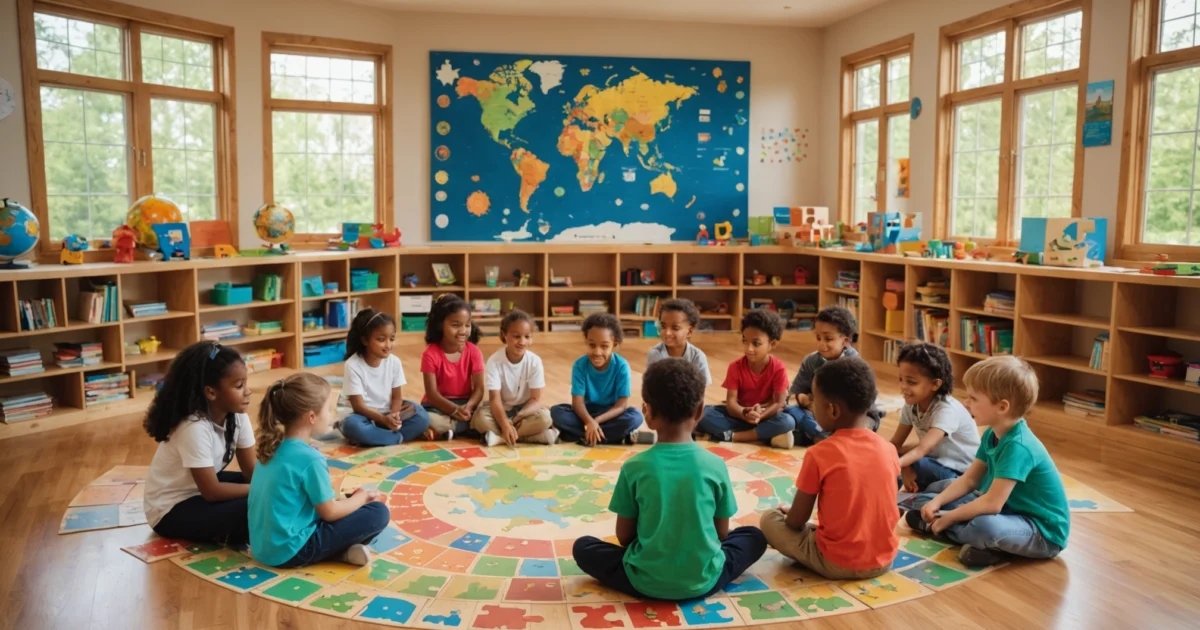
The Montessori cultural curriculum is a comprehensive educational approach that introduces children to geography, history, science, and arts through interconnected storytelling and hands-on exploration. Unlike traditional subject-based teaching, this curriculum emphasizes cosmic education – helping children understand their place in the universe and the connections between all living things. Furthermore, it develops global citizenship by fostering cultural awareness and environmental stewardship through carefully designed materials and Great Lessons that spark natural curiosity.
This holistic approach integrates physical sciences, biology, geography, and history into meaningful learning experiences. Additionally, children explore these concepts through puzzle maps, timeline materials, and classification cards that make abstract ideas concrete. The curriculum progresses from sensorial introduction in early years to specialized research projects in elementary and adolescent programs.
Cultural education in Montessori environments nurtures critical thinking, research skills, and scientific observation while building appreciation for diversity. Moreover, this approach, similar to other child-centered philosophies like the Emmi Pikler approach, respects children’s natural development and encourages independent exploration of their world.
TL;DR
- Cosmic education approach that connects geography, history, science, and arts through storytelling and hands-on materials
- Five Great Lessons introduce universe, life, humans, communication, and numbers as foundation stories that spark curiosity
- Progressive implementation from sensorial exploration (ages 3-6) to specialized research projects (ages 6-18)
- Develops global citizenship through cultural awareness, environmental consciousness, and appreciation for interconnectedness
What is Montessori Cultural Curriculum?
The Montessori cultural curriculum represents a revolutionary educational framework that transcends traditional subject boundaries. Rather than teaching geography, history, science, and arts as isolated disciplines, this approach weaves these subjects into an interconnected tapestry of learning. Cultural education encompasses everything beyond language and mathematics, creating a holistic understanding of our world and humanity’s place within it.
At its core, the cultural curriculum philosophy embraces the concept of cosmic education. This foundational principle reveals how all elements of the universe connect through intricate relationships and dependencies. Children discover that geology shapes geography, which influences biology, which affects human civilization. Consequently, this interconnected worldview helps young learners understand their role as global citizens responsible for Earth’s stewardship.
The curriculum begins with the famous Five Great Lessons that serve as cornerstone narratives. These stories introduce the formation of the universe, the coming of life, the arrival of humans, the development of communication, and the story of numbers. Each lesson sparks natural curiosity and provides context for deeper exploration. Subsequently, children pursue their interests through research, experiments, and hands-on activities that make abstract concepts tangible.
Key Distinction
This approach differs dramatically from conventional subject-based teaching methods. Traditional classrooms typically allocate specific time slots for science, social studies, and arts as distinct subjects. However, Montessori cultural education recognizes that knowledge naturally overlaps and reinforces itself across disciplines. For instance, studying ancient civilizations simultaneously involves geography, history, art, science, and mathematics in authentic contexts.
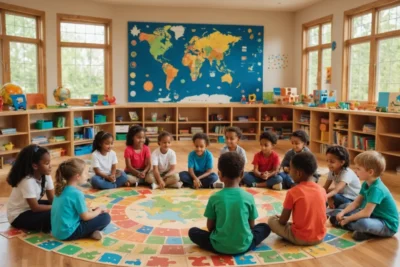
The cultural curriculum develops global citizenship through systematic exposure to diverse cultures, environments, and historical perspectives. Children explore different continents through puzzle maps, study various civilizations through timeline materials, and examine cultural artifacts through classification exercises. This comprehensive exposure fosters appreciation for human diversity while highlighting universal needs and contributions across societies.
Furthermore, cultural awareness emerges naturally as children investigate how geography influences culture, how climate affects lifestyle, and how historical events shape modern societies. They learn that all humans share fundamental needs for food, shelter, clothing, transportation, and artistic expression. Nevertheless, each culture develops unique solutions and contributions that enrich our collective human experience.
The curriculum’s implementation varies across age groups while maintaining consistent philosophical foundations. Preschool children begin with sensorial exploration of cultural materials, elementary students engage in research projects and experiments, and adolescents pursue specialized studies that prepare them for active citizenship. This progressive structure ensures that cultural understanding deepens and expands throughout a child’s educational journey.
Core Components of the Cultural Curriculum
The Montessori cultural curriculum encompasses six interconnected domains that provide children with comprehensive understanding of their world. Each component builds upon the others, creating a unified learning experience that reflects the interconnectedness of all knowledge. These subjects work together to develop critical thinking, cultural awareness, and scientific inquiry skills.
Geography: Foundation of Cultural Understanding
Physical geography introduces children to Earth’s natural features through hands-on exploration of landforms and water forms. Students manipulate three-dimensional models of islands, peninsulas, straits, and bays while learning precise vocabulary for geographic features. This tactile approach helps children understand how geography shapes human settlement patterns and cultural development.
Political geography expands this foundation by introducing countries, continents, and cultural regions through puzzle maps and flag studies. Children learn that political boundaries often reflect geographic features, historical events, and cultural differences. This understanding prepares them for deeper exploration of how location influences lifestyle, economy, and social structures.
History: Timeline of Human Experience
The timeline of life presents Earth’s biological history through visual timelines that span millions of years. Children explore the evolution of plants and animals, understanding their place within the broader context of life on Earth. This cosmic perspective helps them appreciate the interconnectedness of all living things and humanity’s recent arrival in Earth’s history.
Timeline of humans focuses specifically on human development, migration patterns, and cultural achievements. Students examine how early humans adapted to different environments, developed tools and agriculture, and created civilizations. These studies connect directly to geography lessons, showing how climate and resources influenced human development.
Additionally, historical studies investigate specific civilizations, cultural periods, and significant events that shaped our modern world. Children research ancient Egypt, medieval Europe, indigenous cultures, and other societies to understand how past events influence present conditions.
Biology: Classification and Life Sciences
Classification of living things introduces scientific taxonomy through sorting activities and nomenclature cards. Children learn to categorize plants and animals according to their characteristics, developing logical thinking skills while understanding biological relationships. This systematic approach builds foundation skills for all scientific inquiry.
Botany studies explore plant structure, function, and life cycles through hands-on experiments and observation. Students examine seeds, flowers, leaves, and roots while learning how plants adapt to different environments. These investigations connect to geography lessons about climate zones and agricultural development.
Similarly, zoology examines animal characteristics, habitats, and behaviors through classification exercises and research projects. Children study how animals adapt to their environments, migrate across continents, and contribute to ecosystem balance. This knowledge reinforces geographic and historical concepts about human-animal relationships.
Physical Sciences: Understanding Natural Laws
Chemistry concepts emerge through simple experiments with states of matter, chemical reactions, and molecular structures. Children observe how substances change form, combine, and separate while learning basic scientific principles. These hands-on experiences develop analytical thinking and observation skills essential for scientific literacy.
Physics exploration introduces fundamental concepts like gravity, magnetism, light, and sound through manipulative materials and experiments. Students investigate how these forces affect daily life, transportation, and technology development. This understanding connects to historical studies about scientific discoveries and technological advancement.
Astronomy studies expand children’s cosmic perspective through exploration of solar systems, star formations, and space exploration. These investigations help students understand Earth’s place in the universe while connecting to navigation history, calendar development, and cultural mythology.
Art and Music: Cultural Expression
Cultural expressions through art provide windows into different societies’ values, beliefs, and aesthetic traditions. Children examine paintings, sculptures, architecture, and decorative arts from various cultures and time periods. These studies reveal how artistic styles reflect geographic influences, historical events, and cultural values.
Artistic traditions connect to historical timelines, showing how art forms evolve and spread across cultures. Students explore how trade routes carried artistic techniques, how religious beliefs influenced artistic themes, and how technological developments enabled new art forms. This integration demonstrates the interconnected nature of human cultural development.
Language and Literature: Stories of Humanity
Cultural stories preserve and transmit cultural values, historical events, and moral teachings across generations. Children explore folktales, legends, and traditional narratives from different cultures to understand how societies use storytelling for education and cultural preservation. These stories often reflect geographic features, historical events, and cultural practices specific to their origins.
Myths and legends reveal how different cultures explain natural phenomena, historical events, and moral principles through narrative traditions. Students compare creation myths, hero stories, and cultural legends to identify universal themes and unique cultural perspectives. This comparative approach develops critical thinking while fostering appreciation for diverse worldviews.
Moreover, language studies examine how geography and history influence linguistic development, vocabulary, and communication patterns. Children discover how trade routes spread languages, how geographic isolation preserves dialects, and how historical events create linguistic borrowing between cultures.
The Great Lessons: Foundation Stories
The Great Lessons form the cornerstone of the Montessori cultural curriculum, presenting cosmic education through five interconnected narratives that spark wonder and scientific inquiry. These foundation stories introduce children to the universe’s history, life’s development, and humanity’s unique contributions to civilization. Each lesson creates a framework for subsequent detailed studies across multiple disciplines.
First Great Lesson: Coming of the Universe and Earth
The First Great Lesson narrates the universe’s formation and Earth’s geological development through dramatic storytelling and scientific demonstrations. Teachers present cosmic events using visual aids, experiments, and timeline materials that illustrate stellar formation, planetary development, and geological processes. This foundational story establishes the concept of cosmic time and introduces children to astronomy, geology, and physics concepts.
Children explore how stars form elements, how planets develop atmospheric conditions, and how geological forces shape Earth’s surface features. Subsequently, they investigate volcanic activity, rock formation, and continental drift through hands-on experiments and research projects. This lesson connects naturally to geography studies, as students examine how geological processes create the physical environments where life develops.
Second Great Lesson: Coming of Life
The Second Great Lesson chronicles life’s emergence and evolution on Earth, from simple organisms to complex ecosystems. Teachers use the Timeline of Life to demonstrate how living beings adapt to environmental changes and develop increasingly sophisticated survival strategies. This narrative introduces biological concepts while maintaining the cosmic perspective established in the first lesson.
Students discover how early life forms modified Earth’s atmosphere, how plants enabled animal evolution, and how ecosystems develop interdependent relationships. Furthermore, they examine fossil evidence, study adaptation mechanisms, and explore biodiversity through classification activities. This lesson naturally leads to detailed studies in botany, zoology, and ecology.
Third Great Lesson: Coming of Humans
The Third Great Lesson celebrates humanity’s unique gifts and contributions to Earth’s development. Teachers present human evolution while emphasizing distinctive human characteristics: creativity, communication abilities, and the capacity for gratitude and love. This lesson positions humans as cosmic agents capable of conscious choice and environmental stewardship.
Children explore how humans developed tools, created art, established communities, and modified environments through agriculture and technology. Additionally, they study archaeological evidence, examine cultural artifacts, and investigate how human societies adapt to different geographic conditions. This foundation supports subsequent studies in anthropology, archaeology, and cultural geography.
Fourth Great Lesson: Communication in Signs
The Fourth Great Lesson traces humanity’s development of written communication systems from pictographs to modern alphabets. Teachers demonstrate how different cultures created writing systems to preserve knowledge, record history, and transmit information across time and distance. This lesson emphasizes communication as a fundamental human need and achievement.
Students investigate various writing systems, explore how geography influences communication development, and examine how written language enables cultural preservation and scientific advancement. Moreover, they study calligraphy, create their own symbolic systems, and research how printing technology revolutionized information sharing. This lesson connects to language arts, history, and cultural studies.
Fifth Great Lesson: The Story of Numbers
The Fifth Great Lesson reveals mathematics as humanity’s universal language for understanding and describing cosmic relationships. Teachers present how different cultures developed number systems, mathematical concepts, and measurement tools to solve practical problems and explore abstract relationships. This narrative positions mathematics as both practical and beautiful.
Children discover how ancient civilizations used mathematics for architecture, astronomy, commerce, and art. They explore different number systems, investigate geometric patterns in nature, and examine how mathematical discoveries enable scientific advancement. This lesson supports detailed mathematics studies while connecting mathematical concepts to cultural and historical contexts.
How Great Lessons Spark Curiosity and Research
The Great Lessons function as launching points for extensive independent research and collaborative projects. Each narrative raises questions that children pursue through follow-up studies, experiments, and creative expressions. Teachers observe student interests and provide appropriate materials and guidance for deeper investigations.
These foundation stories create emotional connections to learning topics while establishing intellectual frameworks for understanding complex relationships. Students develop research skills, critical thinking abilities, and appreciation for interdisciplinary connections as they explore questions sparked by the lessons. The cosmic perspective encourages children to see themselves as part of ongoing universal development, fostering both wonder and responsibility for their role in the cosmic story.
Cultural Materials and Learning Tools
The Montessori cultural curriculum relies on carefully designed materials that make abstract concepts concrete and accessible to children. These specialized tools transform complex cultural topics into engaging, hands-on learning experiences that support independent exploration and discovery.
Geography and Mapping Materials
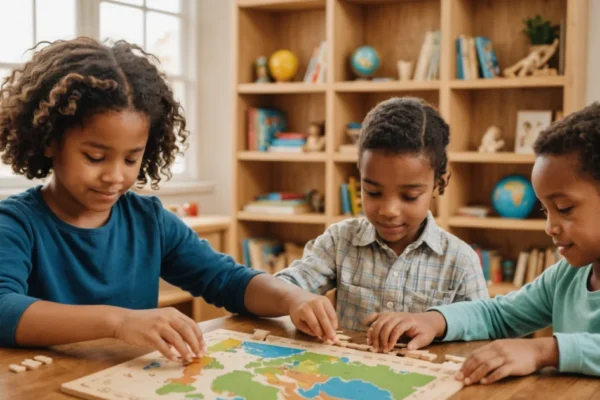
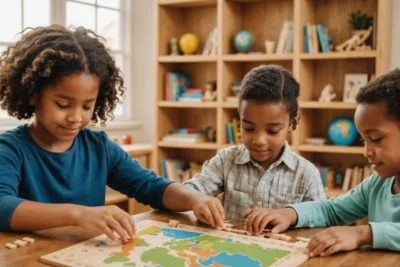
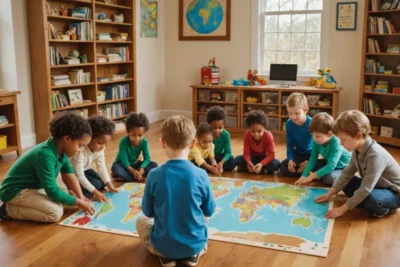
Puzzle maps serve as foundational geography materials in Montessori classrooms. Children manipulate wooden pieces representing continents, countries, and states while building spatial awareness and geographic knowledge. These tactile materials enable students to physically experience the relationships between land masses, developing both fine motor skills and geographic understanding.
Geography materials progress from simple to complex, beginning with the globe of land and water and advancing to detailed topographical maps. Students explore climate zones, biomes, and natural features through specialized materials that isolate specific geographic concepts. This systematic approach builds comprehensive understanding of Earth’s physical and political geography.
Historical Timeline Materials
Timeline materials help children visualize the passage of time and understand historical sequences. The Timeline of Life stretches across classroom floors, allowing students to walk through billions of years of evolution. These materials make abstract time concepts concrete through physical movement and visual representation.
Historical artifacts and replica objects bring past civilizations to life for young learners. Children examine ancient tools, pottery, and artwork while developing appreciation for human cultural development. These tangible connections to history support deeper understanding than textbook illustrations alone.
Classification and Nomenclature Systems
Classification cards organize information into logical categories that match children’s natural tendency to sort and classify. Students work with plant classification cards, animal kingdom materials, and mineral identification sets that support scientific thinking and vocabulary development. These materials follow precise scientific classifications while remaining accessible to elementary students.
Nomenclature materials introduce specialized vocabulary through three-part cards featuring images, labels, and definitions. Children match pictures to words, building reading skills while learning scientific and cultural terminology. This systematic approach supports language development across all cultural subjects.
Science Exploration Tools
Science experiment materials enable hands-on investigation of natural phenomena. Students conduct experiments with simple machines, explore chemical reactions, and investigate physical properties using child-sized laboratory equipment. These materials support the scientific method while maintaining safety appropriate for elementary learners.
Biological specimens and preserved materials allow detailed observation of plant and animal structures. Children examine flower parts, study insect anatomy, and explore geological specimens through magnifying equipment and microscopes. These tools support detailed scientific observation and documentation skills.
Cultural Artifacts and Objects
Cultural objects from around the world expose children to diverse human traditions and artistic expressions. Classrooms feature musical instruments, traditional clothing, ceremonial items, and artistic works representing various cultures. These authentic materials foster appreciation for human diversity and cultural contributions.
Artifact collections support comparative cultural studies as students examine how different societies solve similar human needs. Children compare housing styles, transportation methods, and artistic traditions while developing understanding of cultural adaptation and innovation. This approach builds respect for cultural differences and human creativity.
Research and Reference Resources
Research materials and reference books provide detailed information for independent study projects. Classrooms maintain libraries of field guides, atlases, encyclopedias, and specialized texts that support student investigations. These resources enable children to pursue individual interests while developing research and information literacy skills.
Reference materials span reading levels from picture books to advanced texts, ensuring appropriate resources for diverse learners. Students learn to locate information, evaluate sources, and synthesize findings through guided practice with these carefully curated materials. This foundation supports lifelong learning and academic success across subjects.
Implementation by Age Groups
The Montessori cultural curriculum adapts systematically to children’s developmental stages, progressing from sensorial exploration to abstract thinking. Each age group receives culturally appropriate materials and experiences that build upon previous learning while introducing new complexities. This developmental approach ensures children develop deep understanding rather than superficial knowledge.
Early Years (Ages 3-6): Sensorial Cultural Foundation
Young children experience culture through their senses, touching artifacts, hearing music, and observing visual representations. Sensorial cultural materials include texture boards from different countries, musical instruments for exploration, and picture cards showing diverse architectural styles. These concrete experiences form the foundation for later abstract cultural understanding.
Cultural activities at this stage focus on classification and sorting exercises that introduce basic concepts. Children group flags by color patterns, sort shells by type, and match animals to their habitats through hands-on manipulation. Practical life activities incorporate cultural elements as children prepare foods from different countries and learn traditional crafts.
Geography work begins with the child’s immediate environment, expanding outward to include the classroom, school, neighborhood, and world. Puzzle maps provide tactile exploration of continents and countries while land and water forms introduce basic geographical concepts through concrete materials.
Elementary Years (Ages 6-12): In-Depth Cultural Exploration
Elementary students engage in comprehensive research projects that examine cultural topics from multiple perspectives. Cultural research involves investigating historical timelines, comparing civilizations, and exploring scientific discoveries across cultures. Children develop analytical thinking skills while studying how human needs manifest differently across societies.
Project-based learning characterizes this stage as students choose topics for extended investigation. Research projects might explore ancient Egyptian mathematics, Native American agricultural techniques, or Asian architectural innovations. These studies integrate multiple subjects while developing research methodology and presentation skills.
Collaborative work becomes increasingly important as students share findings and learn from peer research. Cultural presentations allow children to teach others about their discoveries, reinforcing learning while building communication skills. Group projects examine complex topics like migration patterns, trade routes, and cultural exchange.
Adolescent Years (Ages 12-18): Specialized Study and Application
Adolescent learners pursue specialized cultural studies that connect to real-world applications and career exploration. Advanced cultural curriculum includes anthropological field work, historical research using primary sources, and contemporary cultural analysis. Students examine current global issues through cultural lenses while developing critical thinking skills.
Community engagement becomes central as adolescents apply cultural learning to local contexts. Students might document oral histories, participate in cultural preservation projects, or analyze local demographic changes. These experiences connect classroom learning to meaningful community contribution while developing civic responsibility.
Independent research reaches sophisticated levels as students conduct original investigations using academic methodologies. Cultural thesis projects allow deep exploration of chosen topics while developing skills needed for higher education and professional work. Students learn to formulate research questions, gather evidence, and present findings to authentic audiences.
Developmental Progression: Concrete to Abstract
The concrete-to-abstract progression characterizes all Montessori cultural learning, ensuring children develop solid conceptual foundations before advancing to complex ideas. Early sensorial experiences with cultural materials provide the concrete base for later abstract thinking about cultural concepts and relationships.
This developmental approach respects children’s cognitive readiness while challenging them appropriately at each stage. Cultural understanding deepens gradually as students revisit concepts with increasing sophistication, building comprehensive knowledge that supports lifelong learning and global citizenship.
Teaching Methods and Approaches
The Montessori cultural curriculum employs distinctive pedagogical methods that honor children’s natural curiosity while fostering deep cultural understanding. Teachers facilitate learning through carefully designed approaches that encourage exploration, discovery, and meaningful connections across diverse cultural domains.
Child-Led Exploration and Inquiry-Based Learning
Child-led exploration forms the foundation of cultural learning, allowing students to pursue interests that spark genuine curiosity. Teachers observe children’s natural inclinations and provide resources that support deeper investigation into cultural topics. This approach respects individual learning rhythms while maintaining academic rigor through thoughtful guidance.
Furthermore, inquiry-based learning transforms children into active researchers who formulate questions about cultural phenomena. Students develop critical thinking skills as they investigate topics like migration patterns, cultural traditions, or historical events. Teachers support this process by modeling research techniques and providing access to diverse information sources.
Hands-On Manipulation of Materials
Manipulative materials provide concrete experiences that make abstract cultural concepts accessible to young learners. Geography materials like puzzle maps allow children to physically handle continents while learning their names and locations. Similarly, timeline materials enable students to manipulate historical periods, creating tangible connections to past events.
These tactile experiences engage multiple senses simultaneously, strengthening memory formation and conceptual understanding. Children develop spatial awareness through map work, temporal understanding through timeline manipulation, and cultural appreciation through artifact exploration. Physical interaction with materials creates lasting impressions that support advanced cultural learning.
Collaborative Research and Group Projects
Collaborative research mirrors authentic cultural work while developing essential social skills. Students form research teams to investigate complex topics like climate change impacts on different cultures or comparative government systems. These partnerships teach cooperation, communication, and shared responsibility for learning outcomes.
Group projects extend beyond simple cooperation to include peer teaching and knowledge sharing. Older students mentor younger ones, creating vertical learning communities that reflect real-world cultural transmission. Additionally, collaborative work prepares students for future academic and professional environments where teamwork drives innovation and problem-solving.
Integration Across Subject Areas
Interdisciplinary integration characterizes authentic cultural learning, reflecting how knowledge connects naturally in real-world contexts. A study of ancient Egypt might incorporate mathematics through pyramid geometry, language arts through hieroglyphic writing, science through mummification chemistry, and arts through tomb painting techniques.
This holistic approach prevents artificial subject boundaries while demonstrating how cultures develop comprehensive knowledge systems. Students understand that cultural groups create integrated solutions to human needs, combining practical skills with artistic expression and spiritual beliefs. Integration reinforces learning by providing multiple pathways to understanding complex cultural phenomena.
Use of Storytelling and Imagination
Storytelling serves as a powerful vehicle for cultural transmission, engaging children’s imagination while conveying important information. The Great Lessons exemplify this approach, presenting cosmic education through dramatic narratives that capture children’s attention and inspire further exploration.
Imagination becomes a learning tool as children visualize historical events, envision different cultural practices, or project future scenarios based on current trends. Teachers encourage creative thinking through role-playing activities, historical simulations, and hypothetical problem-solving exercises. These imaginative experiences deepen cultural understanding while developing empathy for diverse human experiences.
Outdoor Education and Field Studies
Outdoor education connects classroom learning to real-world environments, providing authentic contexts for cultural exploration. Field trips to museums, historical sites, cultural centers, and natural areas offer direct experiences with cultural artifacts and environments. These excursions transform abstract concepts into concrete realities.
Environmental studies through outdoor exploration help children understand how geography influences cultural development. Students observe how different communities adapt to local conditions, developing unique architectural styles, agricultural practices, and social organizations. Research demonstrates that outdoor experiences enhance environmental awareness while fostering appreciation for cultural diversity and adaptation strategies.
Implementation Tip
Benefits and Learning Outcomes
The Montessori cultural curriculum produces measurable developmental outcomes that extend far beyond traditional academic achievement. Children develop sophisticated thinking patterns while building foundational skills for lifelong learning. Research consistently demonstrates that students exposed to comprehensive cultural education show enhanced cognitive flexibility and improved problem-solving abilities.
Critical Thinking and Research Development
Critical thinking skills emerge naturally through cultural investigations and comparative studies. Students learn to analyze information sources, evaluate evidence, and draw logical conclusions from their observations. Furthermore, research methodologies become second nature as children practice gathering data from multiple perspectives and synthesizing complex information.
Independent inquiry drives intellectual growth as students formulate questions, design investigations, and present findings to peers. These research experiences build confidence while developing essential academic skills for future educational success.
Cultural Sensitivity and Global Awareness
Cultural sensitivity develops through direct exposure to diverse traditions, languages, and worldviews within the curriculum structure. Children learn to appreciate differences while recognizing universal human needs and experiences. Additionally, global awareness expands as students explore interconnections between communities across continents and time periods.
Empathy strengthens through cultural storytelling and perspective-taking activities. Students develop emotional intelligence while building respectful attitudes toward diversity and inclusion in their communities.
Scientific Observation and Environmental Consciousness
Scientific thinking patterns emerge through systematic observation of natural phenomena and cultural adaptations to environmental conditions. Children develop hypothesis formation skills while learning to document observations accurately and objectively. Moreover, observation techniques transfer to other learning areas, enhancing overall academic performance.
Environmental stewardship grows from understanding human relationships with natural systems and resources. Students recognize their responsibility for protecting ecosystems while appreciating how different cultures have developed sustainable practices throughout history.
Learning Integration
Historical Understanding and Timeline Mastery
Historical perspective develops as children work with timeline materials and explore cause-and-effect relationships across different eras. Students build chronological thinking skills while understanding how past events influence present conditions. Consequently, timeline work enhances memory development and sequential reasoning abilities.
Pattern recognition emerges through historical study as children identify recurring themes in human development and cultural evolution. These analytical skills support advanced learning in multiple academic disciplines.
Appreciation for Interconnectedness
Systems thinking develops as students explore relationships between geography, climate, culture, and human adaptation. Children understand how individual actions affect larger communities while recognizing their place within global systems. Furthermore, this interconnected worldview promotes collaborative problem-solving and cooperative learning behaviors.
The cosmic perspective that emerges from cultural education helps children develop purpose and meaning in their learning journey. Students see themselves as active participants in ongoing human development rather than passive recipients of information.
Implementing Cultural Curriculum at Home
Creating an effective Montessori cultural curriculum at home requires thoughtful preparation and intentional design. Parents can establish meaningful learning environments that foster cultural exploration through careful material selection and environmental organization. Moreover, successful implementation depends on following the child’s natural curiosity while providing structured opportunities for discovery.
Creating a Prepared Environment for Cultural Learning
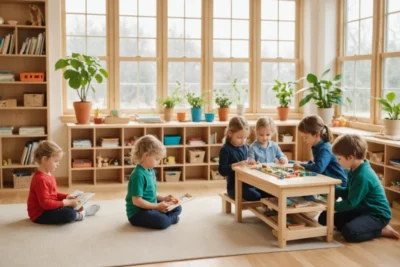
The prepared environment serves as the foundation for cultural education in Montessori homes. Parents should designate specific areas for geography materials, history timelines, and science experiments that remain accessible to children throughout the day. Additionally, low shelves display cultural artifacts, maps, and books at child height to encourage independent exploration.
Natural lighting and organized spaces support concentrated work periods essential for deep cultural learning. Children develop ownership of their learning environment when materials remain consistently available and properly maintained. Furthermore, rotating materials seasonally keeps the environment fresh while introducing new cultural concepts gradually.
Selecting Appropriate Materials and Resources
Quality cultural materials form the backbone of effective home implementation. Parents should invest in puzzle maps, timeline materials, and classification cards that meet Montessori standards for accuracy and beauty. Consequently, children develop precise understanding of cultural concepts through hands-on manipulation of concrete materials.
- Geography materials: Puzzle maps, landform models, flag stands
- History resources: Timeline charts, historical figures, period artifacts
- Science tools: Magnifying glasses, collection containers, identification guides
- Cultural artifacts: Musical instruments, traditional clothing, art reproductions
- Reference materials: Atlases, encyclopedias, cultural picture books
Digital resources complement physical materials when selected carefully for educational value. However, concrete manipulation remains primary in Montessori cultural education, with technology serving as supplementary support rather than replacement for hands-on learning experiences.
Following the Child’s Interests and Questions
Child-led learning drives meaningful cultural exploration in Montessori homes. Parents observe their children’s natural curiosities and provide materials that extend these interests into deeper cultural understanding. Subsequently, learning becomes intrinsically motivated when children pursue questions that genuinely capture their imagination.
Spontaneous questions about animal habitats, weather patterns, or cultural traditions become springboards for extended study projects. Parents can prepare follow-up materials and activities that satisfy children’s curiosity while introducing related cultural concepts. Additionally, maintaining learning journals helps track emerging interests and plan future cultural explorations.
Following Interest Cues
Incorporating Cultural Studies into Daily Life
Daily routines provide natural opportunities for cultural learning integration. Cooking activities introduce world cuisines while developing practical life skills and cultural appreciation. Similarly, weather observations connect to geography and climate studies, making abstract concepts concrete through daily experience.
Seasonal celebrations from different cultures enrich family traditions while expanding children’s cultural awareness. Parents can research holiday customs, prepare traditional foods, and create cultural artifacts that connect learning to lived experience. Furthermore, these celebrations develop appreciation for diversity while building family memories around cultural exploration.
Language learning opportunities emerge naturally through cultural studies as children encounter new vocabulary and concepts. Consequently, cultural curriculum supports language development while building global awareness and communication skills essential for modern citizenship.
Building Connections with Local Cultural Institutions
Community partnerships extend home cultural education through real-world experiences and expert knowledge. Museums, libraries, and cultural centers offer specialized resources and programs that complement home learning initiatives. Therefore, regular visits to these institutions provide children with authentic cultural encounters beyond home materials.
Local experts and community members can share cultural knowledge through home visits or virtual presentations. Children benefit from hearing diverse perspectives and personal stories that bring cultural concepts to life. Additionally, these connections help families build relationships within their broader community while supporting children’s social development.
Adapting Activities for Different Developmental Stages
Developmental appropriateness ensures cultural activities match children’s cognitive and motor abilities. Toddlers benefit from sensory exploration of cultural materials, while preschoolers engage in classification and simple research projects. Subsequently, elementary children pursue complex investigations that integrate multiple cultural subjects.
| Age Range | Cultural Activities | Key Skills Developed |
|---|---|---|
| 18 months – 3 years | Sensory exploration, simple puzzles, cultural songs | Vocabulary, cultural awareness, fine motor |
| 3 – 6 years | Puzzle maps, classification cards, timeline introduction | Geography concepts, historical sequence, research skills |
| 6 – 12 years | Research projects, cultural comparisons, timeline mastery | Critical thinking, cultural analysis, presentation skills |
Scaffolding supports children’s growing independence in cultural exploration. Parents gradually reduce direct instruction while increasing opportunities for self-directed learning and discovery. Ultimately, this approach develops confident, curious learners who pursue cultural understanding throughout their lives.
Assessment occurs through observation rather than formal testing, allowing parents to track genuine understanding and interest development. Children demonstrate learning through their questions, material choices, and spontaneous cultural connections in daily life.
Frequently Asked Questions
What is the Montessori cultural curriculum?
The Montessori cultural curriculum is a comprehensive educational approach that integrates geography, history, science, and arts through interconnected storytelling and hands-on exploration. Unlike traditional subject-based teaching, it emphasizes cosmic education – helping children understand their place in the universe and the connections between all living things.
What are the Five Great Lessons in Montessori education?
The Five Great Lessons are cornerstone narratives that introduce:
- The formation of the universe
- The coming of life
- The arrival of humans
- The development of communication
- The story of numbers
These stories spark natural curiosity and provide context for deeper exploration across all subjects.
How does cosmic education work in Montessori schools?
Cosmic education reveals how all elements of the universe connect through intricate relationships and dependencies. Children discover that geology shapes geography, which influences biology, which affects human civilization. This interconnected worldview helps young learners understand their role as global citizens responsible for Earth’s stewardship.
What age groups does the Montessori cultural curriculum serve?
The cultural curriculum serves children from ages 3-18 with progressive implementation:
- Ages 3-6: Sensorial exploration and introduction
- Ages 6-12: Elementary research projects and deeper investigation
- Ages 12-18: Specialized research projects and advanced study
How is the Montessori cultural curriculum different from traditional teaching?
Traditional classrooms typically allocate specific time slots for science, social studies, and arts as distinct subjects. However, Montessori cultural education recognizes that knowledge naturally overlaps and reinforces itself across disciplines. For example, studying ancient civilizations simultaneously involves geography, history, art, science, and mathematics in authentic contexts.
What materials are used in the Montessori cultural curriculum?
The curriculum uses carefully designed materials including:
- Puzzle maps for geography exploration
- Timeline materials for historical understanding
- Classification cards for scientific concepts
- Hands-on experiments and research tools
These materials make abstract ideas concrete and accessible to young learners.
How does the cultural curriculum develop global citizenship?
The cultural curriculum develops global citizenship through systematic exposure to diverse cultures, environments, and historical perspectives. Children explore different continents, learn about various civilizations, and develop cultural awareness and environmental consciousness that fosters appreciation for interconnectedness.
What subjects are included in the Montessori cultural curriculum?
The cultural curriculum encompasses everything beyond language and mathematics, including:
- Geography and earth sciences
- History and anthropology
- Physical sciences and biology
- Arts and cultural studies
- Environmental science and ecology
How does the cultural curriculum support independent learning?
Similar to other child-centered philosophies like the Emmi Pikler approach, the Montessori cultural curriculum respects children’s natural development and encourages independent exploration. After the Great Lessons spark curiosity, children pursue their interests through self-directed research, experiments, and hands-on activities.
What skills does the Montessori cultural curriculum develop?
Cultural education in Montessori environments nurtures:
- Critical thinking and analytical skills
- Research abilities and information literacy
- Scientific observation and methodology
- Cultural appreciation and diversity awareness
- Environmental stewardship and responsibility
How are the Great Lessons presented to children?
The Great Lessons are presented as engaging stories with visual aids, experiments, and demonstrations. These dramatic presentations capture children’s imagination and provide a foundation for all subsequent learning. Each lesson is designed to inspire wonder and curiosity about the natural world and human achievement.
Can the Montessori cultural curriculum be adapted for homeschooling?
Yes, the Montessori cultural curriculum can be adapted for homeschooling environments. Parents can implement the cosmic education approach by presenting the Great Lessons, using Montessori materials or alternatives, and encouraging child-led research projects that connect multiple subjects naturally.
You May Also Like
What Age Does Montessori End? Complete Guide to Age Limits
Montessori Ideology: Core Principles & Educational Philosophy